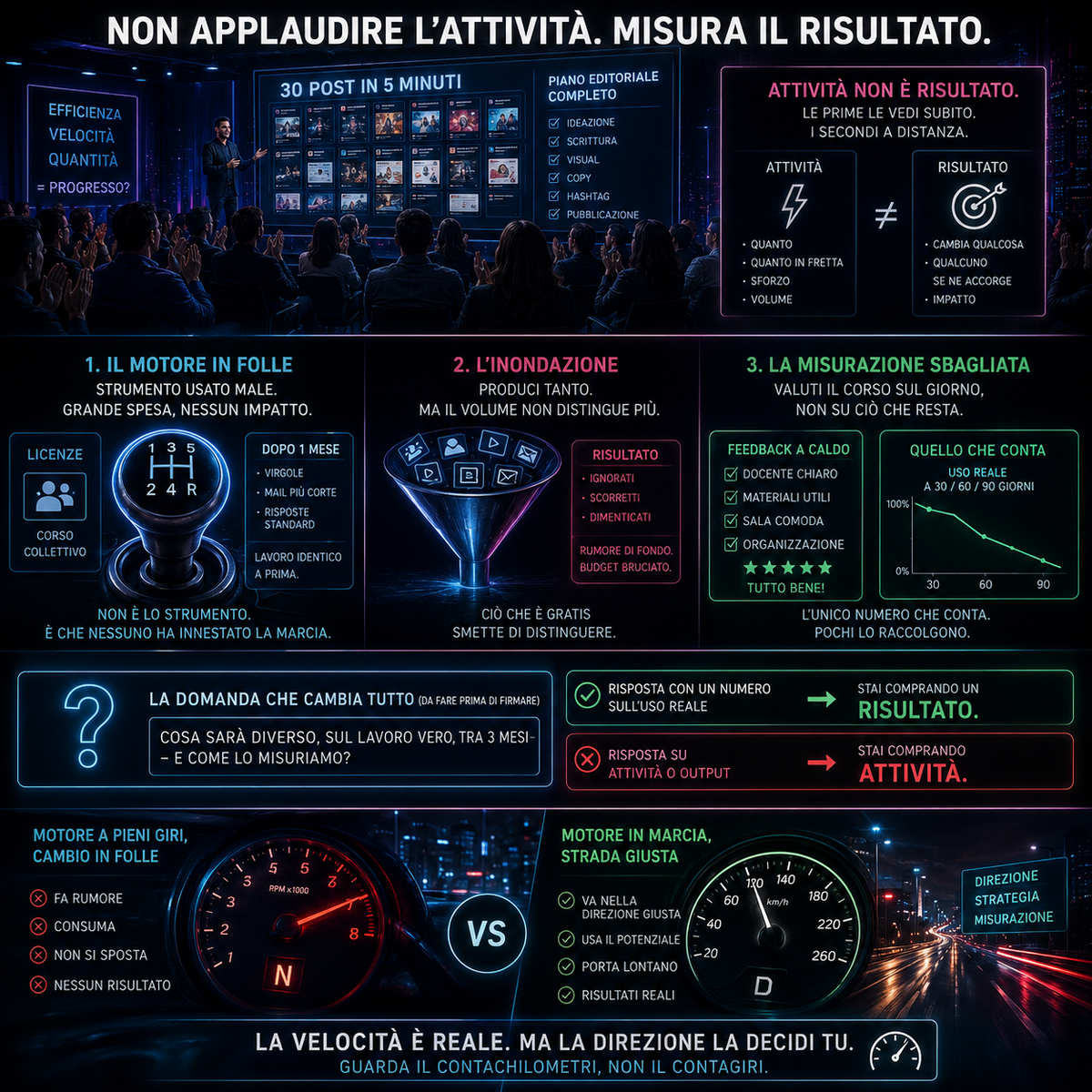
There’s a moment, in certain courses, when the applause breaks out. The screen shows thirty posts ready in five minutes, a whole editorial calendar spat out while the speaker is still talking. The room is impressed. It’s the exact moment the wrong thing gets applauded. Because those thirty posts aren’t a result: they’re activity. And activity and result are two different things — you see the first right away, you see the second over time.
It’s the theater of efficiency. You measure how much, you measure how fast, and you call it progress. But “a lot” and “fast” describe the effort, not the outcome. An engine running at full revs doesn’t tell you where you’re going: it only tells you it’s on. The question that counts isn’t how much stuff you produce. It’s whether that stuff changes anything, and whether anyone notices.
The engine in neutral
The first form of the theater is the most expensive. The company buys the licenses, pays for the group course, puts everyone in a room for three days. A month later, the tool is used to fix commas and shorten emails. They started a racing engine to sit in neutral. It’s not the wrong tool: it’s that nobody taught them to put it in gear — to run real work through that tool. The quote that eats half a day, the analysis nobody has time for, the first draft of a complex offer: there it would move something. On commas, no. Enormous capacity, bought and idle. The spending is beautifully documented. The work is identical to before.
It happens because the training stopped at “look what it can do” and never got to “here’s how you slot it into your Monday.” Knowing an engine does two hundred an hour doesn’t teach you to drive it in traffic. And traffic — your real process, with its constraints and its exceptions — is the only place where the tool either produces value or stays an expensive ornament.
The flood
The second form is the flood. Here you do put the engine on the road, but you point it the wrong way: you produce. A lot. Thirty posts, fifty emails, content on a loop. The reasoning seems solid — the more I produce, the more present I am, the more they find me. It’s false, and for a reason you can verify yourself: the moment anyone can produce thirty posts in five minutes, thirty posts are worth nothing. Volume was a signal while it cost effort. Now it’s free, and what’s free stops distinguishing anything. The web fills with correct, forgettable stuff, and in front of that stuff people and algorithms do the same thing: they scroll past.
The tool amplifies what you give it. Give it an idea that’s worth something, it multiplies value. Give it emptiness, it multiplies emptiness — faster, across more channels, with more budget burned. The thing that’s become scarce isn’t the ability to produce: it’s the judgment about what’s worth producing. One piece of content someone remembers beats fifty nobody notices, and it’s not a matter of taste — it’s that the first leaves a mark and the rest are the background noise your own audience has learned not to hear.
The empty dashboard
The third form is the sneakiest, because it disguises itself as measurement. Course over, someone assesses whether it went well. How? A sign-in sheet and a questionnaire: was the speaker clear, were the materials useful, was the room comfortable. All answers about the day of the course. None about the month after. But a course isn’t judged by how it was experienced: it’s judged by what’s left when the room empties out. And the only number that tells you that is one — how many people, at thirty, sixty, ninety days, are still using the tool on real work. Almost nobody collects that figure, because it’s uncomfortable: it arrives late, and sometimes it says the applauded course changed nothing.
Tachometer or odometer
From here, the tool worth more than the whole theater: one question, to ask before signing off on a course, a license, a rollout. What will be different, on real work, three months from now — and how do we measure it? If the answer is a number about real use, you’re buying a result. If the answer is “we’ll have trained twenty people” or “we’ll have published more,” you’re buying activity — and activity you pay for twice: once in licenses, once in the time it takes away without giving anything back. The tool’s speed is real, and it’s precious. But speed has no direction of its own: you give it one, by deciding what to measure.
An engine at full revs with the gearbox in neutral makes a lot of noise and doesn’t move an inch. The same engine, in gear with the right road ahead, takes you far almost in silence. Between the two, the power doesn’t change. What changes is that someone decided where to go — and watched the odometer, not the tachometer.