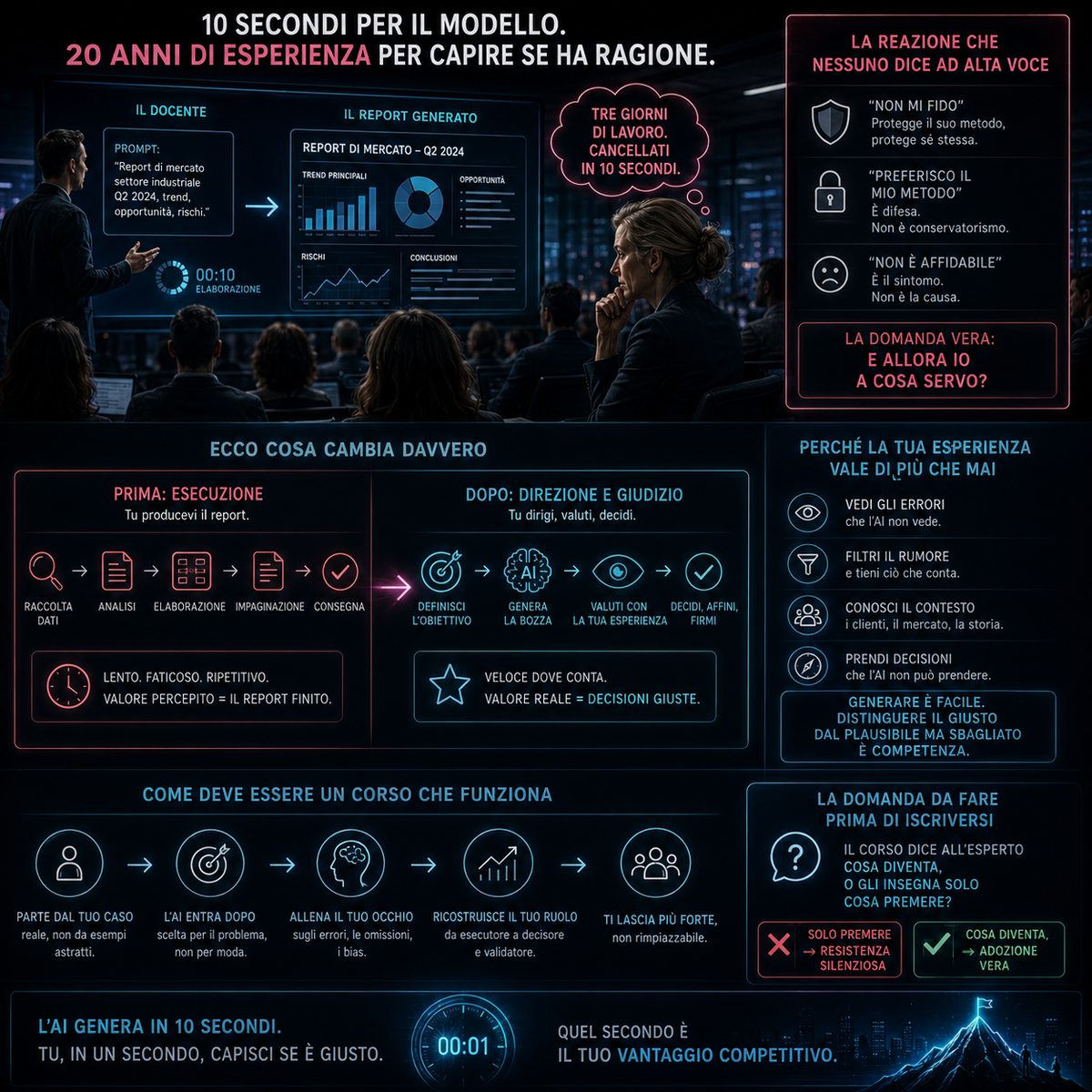
There’s a person, in many companies, everyone turns to. The one who’s been building the market reports for twenty years, who knows which number is off before even checking it, who became the reference point because they put a career into it. Put them in an AI course. At some point the instructor opens the tool, writes two lines, and in ten seconds the report that takes her three days appears on screen. The room sees efficiency. She sees something else: twenty years of craft, apparently reduced in one stroke to a button.
Twenty years in ten seconds
It’s not a fragile reaction. It’s an exact one. When the tool does in an instant the thing you built your value on, the first question that comes isn’t “how do I use it,” it’s “so what am I for.” Nobody says it out loud — they say other things, “I don’t trust it,” “I prefer my own method,” “it’s not reliable” — but that’s the question underneath. And a course that ignores it is building on sand, because the mind of the person sitting in the room is already elsewhere.
It’s not resistance, it’s defense
Here’s the turn almost no course sees: it’s not a technical problem, it’s a problem of role. A person who feels emptied out doesn’t adopt the tool. Not because it’s hard — anyone can press the button — but because using it feels to them like cooperating in their own replacement. So the tool stays open in a browser tab and never really gets used, and you think it’s resistance to change. It’s not resistance. It’s defense. That person is protecting the one thing the course threatened without meaning to: the reason they’re there.
From producer to judge
So let’s say it plainly, because it’s the truth and not a pat on the back. What the model compresses is the execution: putting the report together, laying out the analysis, knocking out the first version. What the model doesn’t have is the twenty years. It hands you back, in ten seconds, an answer that’s confident, fluent, plausible — and sometimes false. In your market, who notices? You. You know which figure is out of range because you’ve seen a thousand, you know which sentence sounds arrogant to a certain buyer, you know what to cut because you’ve watched it fail. That stuff isn’t in the model. It’s in you, and now it’s worth more than before — because everyone can generate, but telling right from convincing-but-wrong is something only those with the craft in them can do.
It’s a change of seat, not a loss of seat. You stop being the one who produces the report and become the one who directs and validates it: you aim the tool, you read what comes back, you decide what holds and what doesn’t, you sign. The mechanical part drops below you, and you move up to the part that counts — judgment. For an expert it’s a promotion disguised as a demotion. The beginner uses AI to do things they couldn’t do; the expert uses it to do more than they already can, and to catch when it’s wrong. The gap between the two doesn’t shrink. It widens.
What you become, not what to press
That’s why training that works doesn’t stop at teaching the button. Teaching a senior the button is almost an insult: the button is the easy part. The real work is rebuilding their role — showing them, on their own real case, where their experience becomes the filter the tool doesn’t have, where their eye catches the error the model hid elegantly. A course that does this doesn’t leave frightened people in the room: it leaves people who’ve understood they’re holding a lever, not a sentence. A course that stops at the button, instead, gets the opposite of what it was paid for: it takes your best people and demotivates them, one by one.
There’s a question that reveals it, before sending experienced people into a course: does the course tell the expert what they become, or only teach them what to press? If it stops at the pressing, brace for the silent refusal — and it’ll come from exactly the people you need most, because they’re the ones with the most to lose if AI is really what they fear. It isn’t. But someone has to tell them the right way, and show them on their own work, not reassure them with a slogan.
The model generates the report in ten seconds. What it doesn’t know is whether it’s right — and in twenty years of craft that’s exactly what you’ve learned to see. That second in which you look at the number and realize it’s perfect and false, no machine takes from you. And it’s that second, today, that’s worth more than the whole report.