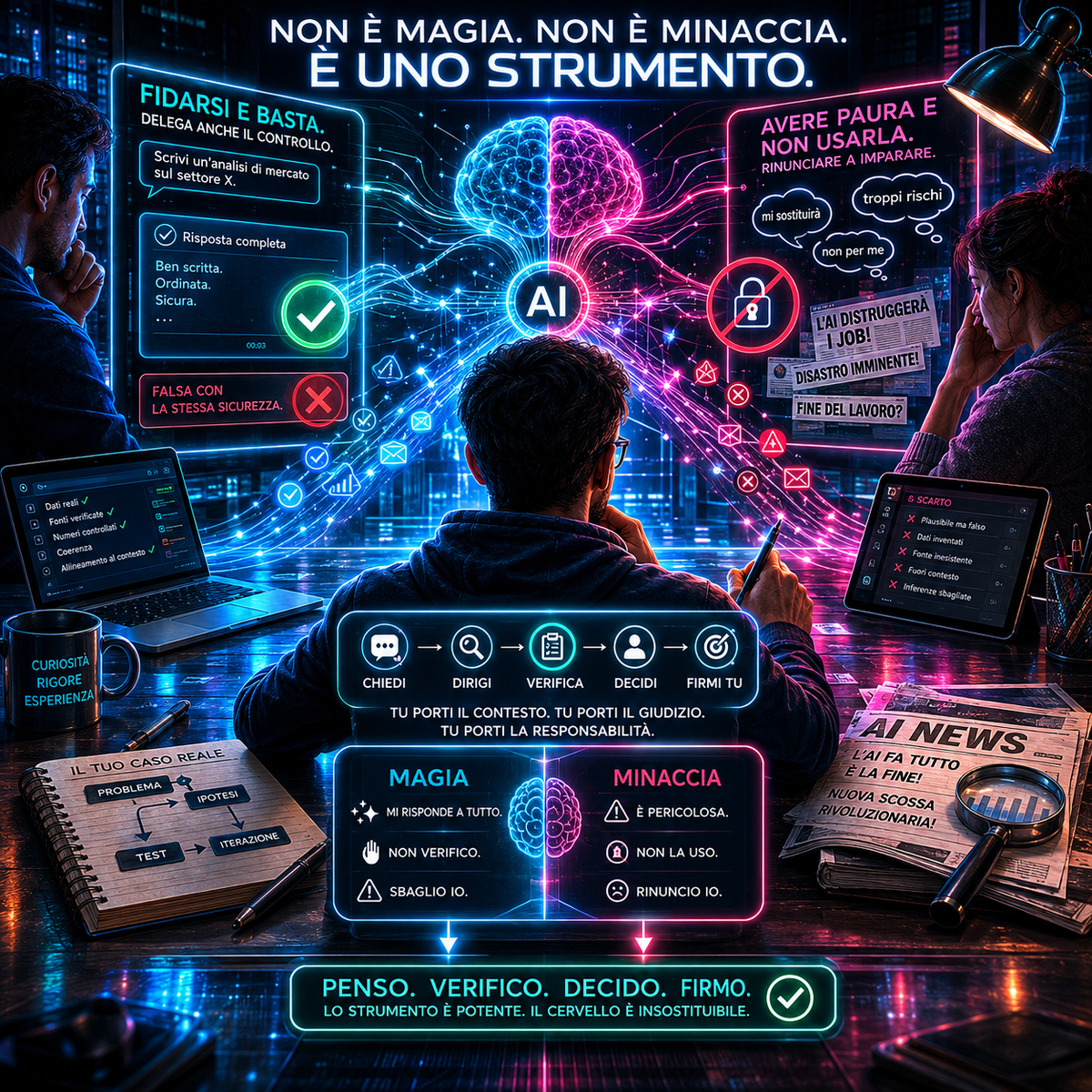
Ask a model something and in a few seconds an answer arrives. Well written, tidy, confident. Sometimes it’s right. Sometimes it’s flat wrong — and it arrives with exactly the same confidence. No hesitation, no warning. The false sentence is laid out as nicely as the true one. That’s the fact everything else starts from: the form tells you nothing about the substance.
Faced with that fact, people go wrong in two opposite ways. Some just trust it: they take the output, don’t reread it, send it to the client. And some are afraid: they read every piece of AI news as a countdown, and keep their distance from the tool. The two attitudes look far apart. They’re the same mistake with two faces — both have stopped thinking. One out of trust, the other out of fear.
The box that knows everything
The first myth is that it’s a box that knows. You call it magic because it spares you effort, and sooner or later you hand it something without checking. It’s fine ten times. The eleventh, it hands back an invented figure wearing the face of a real one, you don’t verify it, and that number ends up in a quote. The point isn’t that the model got it wrong: it always will, now and then. The point is that you delegated the checking too. The fast machine merely sped up a mistake of yours.
From here comes the first real skill, the one worth more than any list of tricks: spotting an answer that’s plausible but false. There’s a criterion that holds. These tools seem competent about anything, but they’re not equally reliable everywhere. On your own trade — your numbers, the rules of your sector, what you’ve watched work and fail — you’re the judge, because you catch on the spot when a sentence sounds right but isn’t. Outside your field, you can’t swallow that same confidence without checking the source. And yes: sometimes it cites the source to you, and it doesn’t exist.
Fear dressed up as caution
Then there’s the other face, talked about less because it hides better. Fear. The person who feels it often doesn’t say so, and dresses it up as caution: “I’d rather not trust it.” But there’s a difference between not trusting a single output — healthy, right — and not touching the tool out of fear of what it means. Underneath, the fear is almost always one thing: that the machine makes the person useless.
It’s worth facing instead of circling around it. The work a model does in your place is the mechanical part: the first draft, the rough version, the template to fill in. What it doesn’t do is take responsibility for that draft. Deciding whether it’s true, whether it’s worth sending, what to do with it: that stays an act of yours, and you’re the one who signs it. Whoever keeps that distinction clear doesn’t feel emptied out by the tool — they lean on it to free up time and spend it on the part that counts, judgment. Whoever stays away out of fear isn’t protecting themselves from anything: they’re just giving up on learning to steer it, while someone else learns. Real caution isn’t keeping your hands off. It’s keeping control over what the tool produces.
Panic, or a real limit?
There’s a third thing the right posture gives you, and it concerns what you read. Every week a headline comes out: either AI has just made some job obsolete, or it’s about to cause a disaster. The useful question isn’t “is it true?” It’s: “can I verify this with my own hands, or is it a prediction?” A real limit you touch when you bump into it on a job of yours — not when you read about it. The rest, the headline that shouts, is usually the writer’s anxiety dressed up as news. Separating noise from signal isn’t a matter of being informed: it’s a matter of trying, on your own cases, and seeing where the tool holds and where it gives way.
Neither oracle nor threat
The posture that works, then, doesn’t sit in the middle like a lukewarm compromise. It’s a precise way of working. You treat the model as the fastest collaborator you’ve ever had: tireless, with a vast memory, and every so often dead sure while it says something stupid. You question it, you direct it, you verify what it produces — as you would with someone very good and a bit too cocky. You don’t worship it, because you know it can be wrong. You don’t fear it, because you know you’re the one who decides. It’s the most powerful tool that’s ever passed through your hands. A tool, precisely: the hand stays yours.
Magic and threat have one thing in common. Both ask you to stop thinking. And thinking is exactly the part that no tool, however powerful, takes out of your hands.