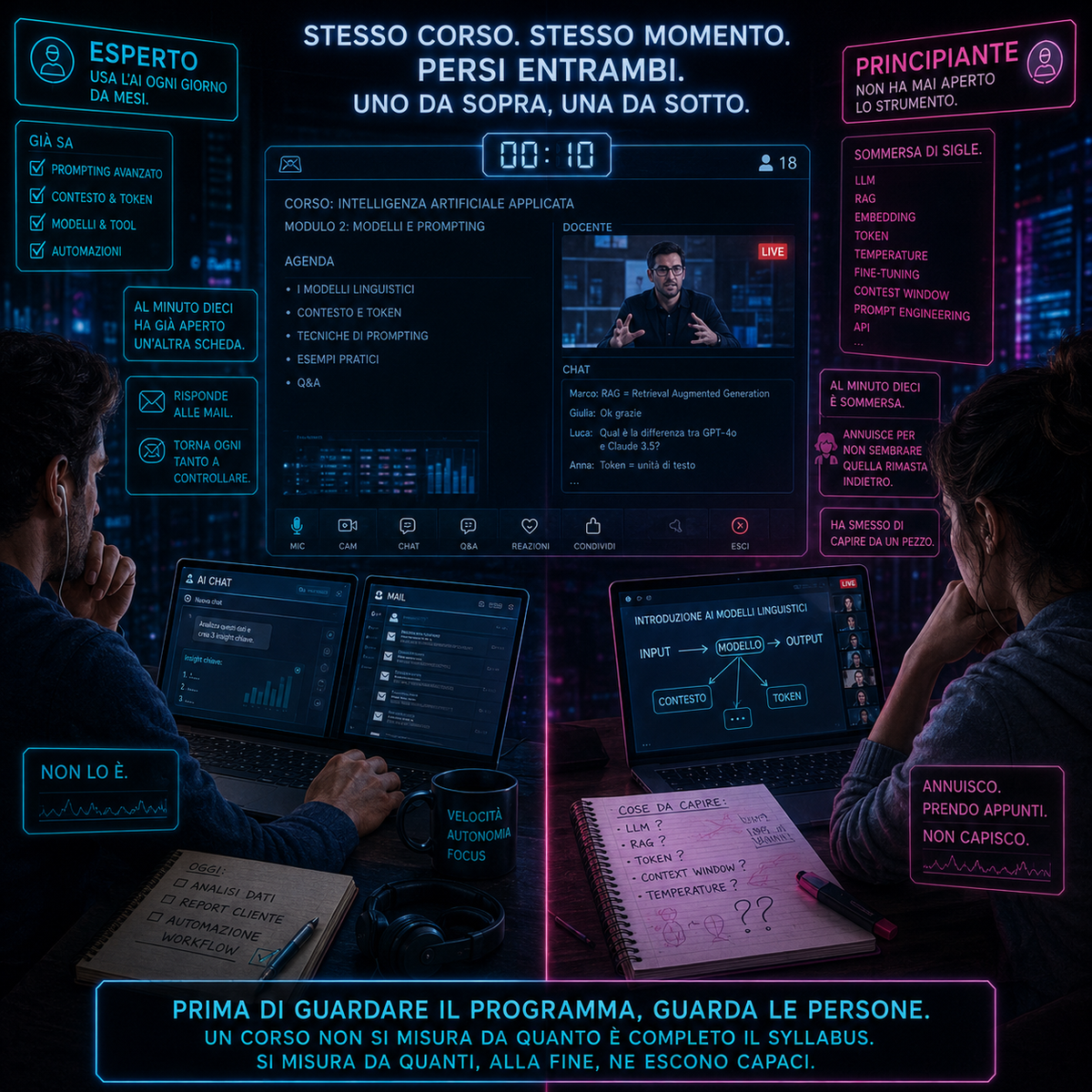
Same virtual classroom, two people. One has used the tool every day for months: by minute ten they’ve already opened another tab, they’re answering email, dropping back now and then to check whether anything new has been said. Nothing has. The other has never opened it: by minute ten they’re buried in acronyms, nodding so as not to look like the one falling behind, and they stopped following a while ago. Same course, same instructor, same moment. Both lost — one from above, one from below.
Two exits, same door
They look like opposite problems. They’re the same problem.
Boring the experienced and losing the absolute beginner come from the same single omission: not having looked at who’s in front of you before you opened your mouth. Treat the expert like a beginner and you lose them to boredom — they check out, and they don’t come back. Treat the beginner as if they already owned the terminology and you lose them to overload — they nod, take notes they won’t be able to reread, and walk out convinced they’re hopeless. Two different exits from the same door. And the asymmetry is cruel: the expert leaves and writes that the course was trivial; the beginner leaves and blames themselves. Neither one blames the person who didn’t look at them.
The myth of the average level
The silent culprit has a reassuring name: “the average level.” A course calibrated for a median participant — who doesn’t exist — misses both of the real ones. It’s wonderfully easy to design. It reaches no one. The average level is a statistical mean, not a person sitting in front of you.
Diagnosis comes first
What changes everything comes before the program: understanding what each person can already do and which words they actually own. And don’t ask out loud — who raises a hand to say “I’m the one furthest behind”? Nobody. Nobody declares themselves a beginner in front of colleagues, and almost everyone overestimates what they can do with a tool they’ve only watched someone else use. The read has to be concrete: what you actually use already, what you’ve stopped using and why, the problem in front of which you stall. From there you decide what to teach and how to say it. This holds for a tailored course and it holds for an off-the-shelf one: even a fixed program you deliver in different registers, if you know who you’re talking to.
Remotely, you don’t make that read by eye. In a room you see the face of the one who’s lost, the arm that doesn’t go up, the gaze drifting out the window. Behind twenty dark tiles you see nothing. So diagnosis stops being a hunch you refine along the way and becomes a formal step, before the course begins. Remote isn’t the limit: it’s the reason you stop guessing the level and start measuring it.
The opposite happens more often than it should — I’ve seen it too many times. A company sends an entire department to the same course, same hour, same program. The two most seasoned check out in the first half hour — stuff they’ve been chewing on for ages. The two who just arrived drown in the glossary and never recover. In the middle, a few keep up. A certificate for everyone. Three weeks later, the verdict is “AI isn’t for us.” Wrong: the course didn’t fail, the leveling failed. They funneled five different levels into the same pipe and were surprised little came out. The fix fits in one line: there’s no such thing as “the right course” — there’s the course that’s right for whoever receives it.
The part a model won’t give you
And here’s the part a model won’t give you. Generating a three-level program is a matter of minutes, and AI does it well. What it doesn’t do is the read. When one person tells you “I’ve already tinkered a bit” and means they’re genuinely advanced, and another says the exact same sentence but means they watched a video, you’re the one who catches the difference — from the way they say it, from what they ask next, from where they get stuck. Raising the bar the moment you see you’re boring someone, slowing down the instant you see you’re losing someone: that real-time calibration is human skill, and it doesn’t get delegated. AI prepares the materials for every level. Who goes to which level, you decide.
Before you look at the program, look at the people. A course isn’t measured by how complete the syllabus is. It’s measured by how many, at the end, walk out capable — and that number collapses the exact instant you stop asking who’s in front of you.